
Don't Make 3x the Rent? How to Meet the 3x Rule in Texas
Don't make 3x the rent? Here's how the 3x rule works in Texas, which kinds of communities ask for less, and how a roommate, deposit or guarantor can help.
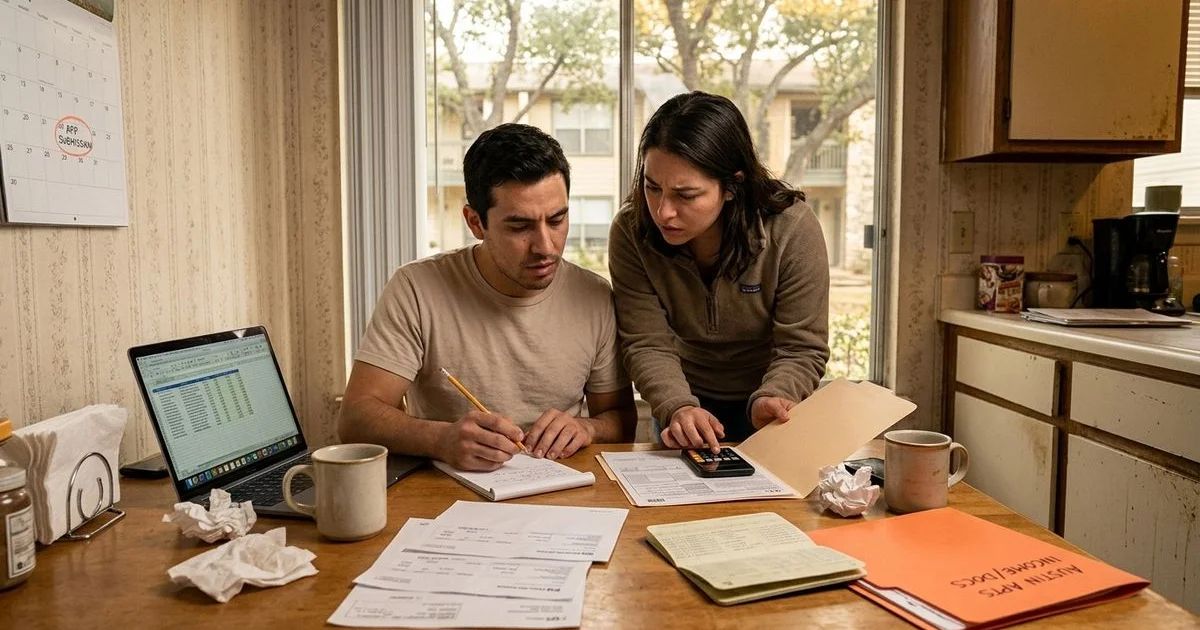
Last reviewed October 4, 2026. This is general information about renting in Texas, not legal or financial advice. Laws, prices, and screening rules change, so confirm details with each community and talk with an attorney about your own situation.
From what we see every day, the 3x rent rule is the line between an easy approval and a huge headache in Texas. It's one of the most common screening shortcuts in the U.S., and it frustrates renters more than almost anything else on the application.
Your monthly income before taxes has to be at least three times the rent.
So a $1,500 a month apartment needs $4,500 a month before taxes, and a $2,000 apartment needs $6,000. If you don't make 3x the rent on your own, the application usually gets flagged before a person ever reads it.
This rule bends more than the application makes it look. Let's go through the numbers and a few real ways around it.
Why landlords use the 3x rule
The 3x rule works out to rent taking about 33% of your income. Communities use it as a quick check on whether you can cover rent, keep the utilities on, handle everything else, and still pay on time.
Property managers like this math since it matches the federal rule of thumb for what's affordable.
The U.S. Department of Housing and Urban Development says anyone spending more than 30% of their income before taxes on housing is “cost burdened.”
Rents differ a lot between Austin, Houston, Dallas, Fort Worth, and San Antonio, so run the math on the unit you actually want. Say a one bedroom costs $1,400 a month.
That means you need at least $4,200 a month before taxes to get past the screening software for that unit. The 3x rule is a rule of thumb, not a law. Every community uses it a little differently, and some barely use it at all.
Four ways in when you fall short
If your income doesn't hit the number, you have four main ways to still get approved. Often the answer is a mix. You might add a roommate at a community that asks for less, or use a guarantor plus a higher deposit.
- Communities that ask for less. Some Texas communities use 2x or 2.5x instead of 3x. When clients don't make 3x, we often look at suburban communities around their metro. Workforce housing and communities where a person reviews each file are usually your strongest bets there. The catch is usually a slightly higher deposit.
- A second income on the lease. A roommate, partner, family member, or spouse who lives with you can add their income to yours to hit the number. Most communities allow this, but they often want both of you to pass the credit check.
- Guarantor or co-signer. Someone who doesn't live with you signs the lease as a backup. Most often it's a family member with strong income. If family can't help, we like paid guarantor services such as Jetty, TheGuarantors, or Liberty Rent. These companies charge an upfront fee you don't get back, often about 40% to 130% of one month's rent, depending on your file. Our comparison guide shows which option fits which situation.
- Higher security deposit. Some Texas communities will take a higher deposit than normal when your income falls short. You'll see this a lot at workforce communities, but less often at Class A properties that let the software decide.
Which Texas communities ask for 3x, 2.5x, or 2x
Keeping track of which community asks for what takes a database, since the rules change all the time. The pattern depends a lot on the neighborhood and on the management company's screening software.
We sort properties into four groups based on what they ask for in 2026.
- 3x, no exceptions: Many Class A downtown properties and big corporate communities in each metro work this way. They often use screening tools like RealPage or First Advantage. Those can deny anyone below the line automatically.
- 3x, but a person reviews close calls: Most midrange communities we track fall here. If your income is close, someone looks at it case by case, especially if you have solid savings.
- 2.5x: A good number of workforce housing properties use this, often in the suburbs. You'll find it at some older close-in communities too.
- 2x: This is a smaller slice of the market. These are usually older workforce communities with more room for judgment calls.
Ask the leasing office exactly how they check income before you pay any application fee. A quick phone call can save you the fee on every application that was never going to work.
Adding a second income to your application
When you apply with a roommate, partner, or family member, most communities add your monthly incomes together. The math works like this. If you make $3,000 and your partner makes $2,500, your $5,500 combined qualifies you for an $1,800 apartment at 3x.
We always warn clients that applying together means sharing the risk. Both of you usually need to pass the credit check, though sometimes the stronger applicant can carry the other. Each person pays their own application fee for the background check.
Even when one person pays all the rent, you're both legally on the lease. If a payment gets missed, each of you is on the hook for the full amount.
| Requirement | You | Your Roommate or Partner |
|---|---|---|
| Application Fee | Yes (usually about $50 to $85) | Yes (usually about $50 to $85) |
| Credit Check | Required | Required |
| Who Owes the Rent | On the hook for 100% | On the hook for 100% |
When your debt matters more than your income
Some communities care more about how much of your income already goes to debt. They call this your DTI, short for debt to income ratio. If you have monthly payments, the community takes them out before running the 3x math. Debts that usually count include:
- Student loans
- Auto loans
- Minimum credit card payments
- Personal bank loans
Many screening systems want your total debt payments, rent included, to stay under a set share of your income. At these communities, someone making $5,000 a month with $1,500 in monthly debt payments looks like they make $3,500.
Check your credit report for your exact minimum monthly payments before you apply. DTI screening cuts both ways. It hurts if you carry a lot of debt, but it helps if your debt is low and your income is modest.
How we help
When you start a profile, tell us your monthly income and any big debts so we can match you with the right properties. We work with every credit score, including under 500, and with first time renters who have no credit history yet. We pull communities where your income already clears the bar, plus ones where a roommate or guarantor can realistically close the gap.
Your list gets longer if you're open to more than one of these options. It gets shorter if you need to qualify on your income alone.
We take the guesswork out of the 3x rule for apartments across Texas. Tell us your situation to get started. We'll send you a shortlist within 24 to 48 hours on weekdays, free and with zero judgment.
Frequently Asked Questions
What is the 3x rent rule?
Most apartment communities want your monthly income before taxes to be at least three times the rent. So for a $1,500 a month apartment, they want $4,500 a month before taxes. It's a quick way for them to guess whether you can comfortably afford the rent.
What if I don't make 3x the rent?
You have four common options. Find a community that only asks for 2x or 2.5x. Add a roommate or partner whose income counts with yours. Use a guarantor or co-signer. Or pay a bigger deposit to cover the gap. Often it's a mix.
Can two incomes be combined to meet 3x?
Yes. Most Texas communities add both incomes together to hit the 3x number. Two people making $2,500 a month each ($5,000 combined) can qualify for a $1,500 apartment when neither could alone.
Ready to get a real list of apartments that fit your situation?
Our licensed Texas locators check you against each community's real screening rules, so you only apply where your file fits. It's 100% free.
Get My Free List